Short answer: A Doha interior design ad should help a potential client picture the project you can actually deliver. Show the type of space, your role, the work included, the location you serve and what happens after an enquiry. A beautiful moodboard may attract attention, but it rarely answers all of those questions.
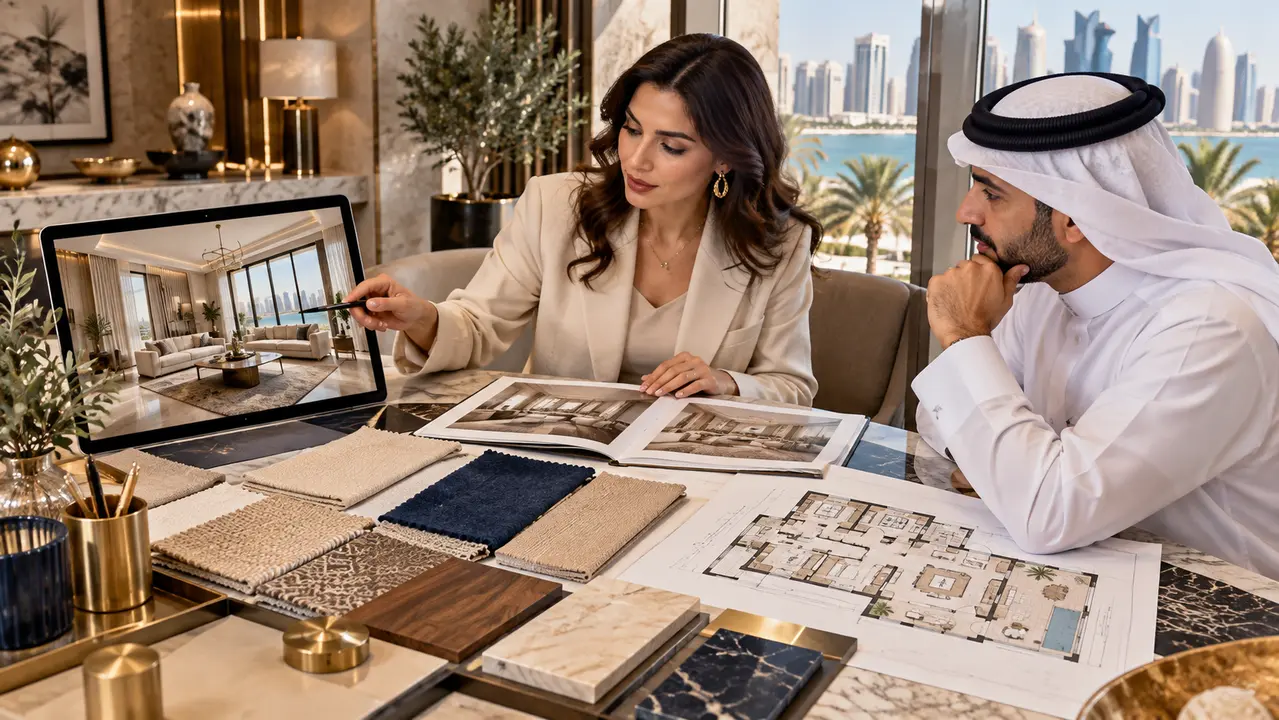
Why a portfolio image alone may leave a buyer unsure
Imagine a business owner looking for an office redesign. Your ad shows an elegant room and says, “Luxury interiors, made for you.” The image is appealing. But the owner still cannot tell whether you design offices, manage fit-out work, accept projects of that size, or work at their location.
That gap matters most when the service is expensive and decisions take time. The aim of the ad is not to make every viewer submit a form. It is to help a suitable buyer understand whether a conversation is worth having.
Here is a stronger illustrative example, not a real campaign result: “Office interior design in Doha: space planning, material selection and a documented handover. View a completed office project and tell us the size, location and desired start date.” It is less glamorous, but much clearer about the work.
Start with the work your studio actually sells
“Interior design” can mean different things to different buyers. Before writing an ad, decide which service the creative represents:
- Concept design only, including layouts and visual direction;
- Design plus drawings, specifications and material selection;
- Design and fit-out coordination, if your team genuinely provides it;
- A specific property type, such as a villa, office, shop or restaurant.
Do not combine services in the ad if the contract does not combine them. Instead, describe the deliverables you can show. One real project can become a small case study: the original brief, a design decision, what your team delivered, and what remains outside your scope. Obtain permission before publishing client plans, images or identifying details.

Make the proof useful, not merely polished
A strong project page answers the questions a buyer would ask in a first meeting. What kind of space was it? What problem did the client want solved? What did the studio do? Which details can be seen in the photographs? What cannot be inferred from the photographs?
For example, a “before and after” image can show a change in layout or finish. It cannot, by itself, prove that a project came in on budget or that staff became more productive. If you make either claim, provide evidence and its context. Otherwise, describe the visible work and stop there.
If a project is still underway, label the rendering as a concept. Do not present it as a finished installation. The difference is meaningful to a client comparing studios.
Give Doha buyers a precise service-area answer
“Doha” can be used casually to describe a wider urban area, while Qatar’s official planning materials distinguish Doha Municipality from Al Rayyan Municipality. The government planning pages even identify Gharrafa Town Centre as partly in each. That is a useful reminder: a studio should list the places it truly serves rather than assume a city label covers every potential project.
Write a simple sentence on the ad or landing page: “We take design projects in [your actual areas]; site visits elsewhere in Qatar are assessed individually.” Replace the brackets with your genuine coverage. If travel changes the fee or timeline, explain how that is assessed before the buyer books a meeting.
If you use Google Ads, check the location setting rather than relying only on the target name. Google says location targeting can include people physically in a place and people who have shown interest in it; its default option may use both. The settings are estimates, not a perfect geographical fence. Review the location report and the actual project addresses in your enquiries. This is a platform-specific implementation note, not a claim that a platform is required for every studio.
Write the Arabic customer-facing version carefully
Qatar’s Ministry of Commerce and Industry says its consumer-rights guidance covers accurate service information and Arabic-language advertising and documents. The Ministry has also stressed clear pricing, sufficient service information and avoidance of misleading ads. For a studio advertising in English, that is a reason to prepare and review the Arabic customer-facing material too, and to check how the current requirements apply to your exact ad and contract with qualified local advice.
Translation alone is not enough if it changes the scope. The Arabic and English versions should agree on whether a consultation is paid, what the design package includes, who handles procurement and whether fit-out is included. If a portfolio photograph is a concept rendering, label it consistently in both languages.
Build an enquiry path that respects a long decision
Do not ask for a full design brief before earning trust. Give the buyer a clear first step: view a relevant project, understand the service, then request a conversation. A short enquiry form might ask:
- Is the project a home, office, shop or another type of space?
- Where is the site?
- Is the buyer seeking design only or help with implementation?
- What is the approximate timing?
- What is the best way to contact them?
If project budget is essential to decide fit, you can ask for a broad range and explain why. Avoid implying that every enquiry will receive a fixed quote without reviewing the project. After the form, say when and how the studio will reply, using a response time your team can meet.
A practical review before spending more
Open one of your current ads and its destination page side by side. Can a buyer tell, without calling you, which project type it shows, what your studio delivered, where you work and how the next step works? If any answer is missing, fix the page and message first. Then compare the quality of enquiries by project type and location in your own records. A lower cost per form is not useful if most forms are for work you do not sell.
Frequently asked questions
Should a Doha design studio show prices in its ads?
If a fixed package has a genuine price, state its scope and conditions clearly. For custom work, explain how the estimate is prepared rather than inventing a starting figure that does not reflect typical projects. Check local display and consumer-information requirements for the precise offer.
Can we advertise with concept renders?
Yes, as examples of proposed design, provided they are clearly labelled as concepts. Do not let a viewer mistake them for completed work.
Sources and method
Government and platform documents were checked on 27 September 2026. The project examples above are illustrative; no conversion rates or market results are claimed. The recommended ad structure is our practical analysis of what a buyer needs to assess a studio.