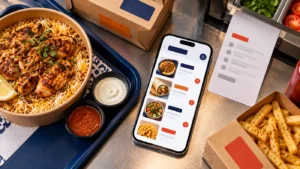
How can a Saudi online store turn an ad click into a confident purchase? Show the product and price clearly, then make the store’s identity, delivery terms, returns process and contact route easy to find before checkout. An ad can earn attention. The buying journey has to answer the questions that attention creates.
This guide is for Saudi ecommerce owners reviewing their own store and campaigns. It draws on the Saudi Ministry of Commerce’s published store evaluations, but it is a marketing workflow, not a legal compliance certificate.
Why this matters in Saudi Arabia now
Saudi Arabia’s Ministry of Commerce evaluated major online stores against ten criteria in 2025. Its published criteria included store authentication, exchange and refund policies, shipping and delivery information, complaint handling, privacy, contact details, and secure site quality. In January 2026, the ministry reported a further evaluation covering 220 online stores against ten criteria.
Those are observations about the stores evaluated, not a conversion study and not proof that adding one policy will increase sales by a fixed percentage. They do tell an owner which parts of the customer experience local authorities consider material. The 2025 breakdown also showed weaker compliance in complaint policies and two store verification measures than in basic contact and return-policy visibility.
If an ad promises convenience but the landing page hides shipping time or the route to a refund, the customer has to resolve that uncertainty alone. Our practical inference is to make those answers visible where the decision happens.
Map the question at each stage
Open one of your current ads on a phone and follow it as a first-time shopper. Do not jump straight to the checkout screen. Note the exact question a shopper must answer before each tap.
- Ad: What is being offered, for whom, and at what starting price or price range?
- Product page: Are the specifications, options, stock status and total cost clear?
- Before payment: What is the delivery estimate and what are the relevant return or exchange conditions?
- After purchase: Where can the buyer find order support and submit a complaint?
A vague “shop now” message cannot repair a missing answer later. The ad and the destination should describe the same offer.
Build a trust-first campaign brief
1. Choose one product and one buyer question
Do not start with a general claim that your store is “trusted.” Pick one buying hesitation you can actually address. For a furniture product, it may be dimensions and delivery. For a skincare product, it may be ingredients and the return conditions for opened items. Check the rules applicable to your category before making a claim.
2. Put verifiable details in the creative
Show the item at a useful scale, demonstrate a feature, or reveal what is included. If an offer has conditions, state them plainly. Avoid inventing a scarcity deadline or implying a government endorsement.
3. Match the landing page
Send the customer to the relevant product or collection, not an unrelated home page. Make the price, shipping information and support path visible on mobile. Link to the store policies in plain language. Where required, show your accurate registration and tax details; confirm current obligations with the relevant authority rather than copying another store’s footer.
4. Measure the whole journey
Track ad clicks and product-page visits separately from add-to-cart, checkout and completed orders. A high click-through rate with low product-page engagement points to a different issue from a strong product page with abandoned checkout. Check the pages and events are measured correctly before interpreting any pattern.
A simple example, with no invented results
Hypothetical example: A Riyadh homeware store advertises a storage unit. Version A says, “Elegant storage for every home.” Version B shows the unit beside a sofa, gives its dimensions, identifies the finish, and points to a page with the delivery area and return conditions. The owner tests the two messages with the same landing-page quality and records product-page visits, checkout starts and completed orders. Neither version is guaranteed to win; the test asks which information helps this store’s real customers decide.
Before running that test, ask three recent customers what was unclear in the buying journey. Their wording may reveal a question the campaign brief missed.
What to fix before increasing ad spend
- Check that the store’s public identity and required business details are accurate and easy to find.
- Read the shipping promise from a customer’s perspective, including timing and relevant charges.
- Make return, refund and complaint routes understandable on a phone.
- Test a complete order and a support request yourself.
- Confirm that the ad, product page and checkout use the same price and offer terms.
One-hour action: Record your phone screen from ad click to the final payment step. Pause every time you need to guess. Write that question down, assign an owner, and fix the most consequential missing answer first.
Conclusion
Saudi ecommerce marketing works better as a connected decision journey than as an isolated ad. A useful campaign gives a shopper a reason to click; a clear, verifiable store experience helps them decide whether to buy. Start with the buyer’s unanswered questions, then write the ad and page together.
Sources and method
Saudi market context was checked against the Ministry of Commerce’s 2025 evaluation announcement, its published compliance breakdown, and the January 2026 evaluation announcement. Sources were reviewed on 5 October 2026. The campaign workflow and hypothetical example are editorial recommendations, not results reported by the ministry.